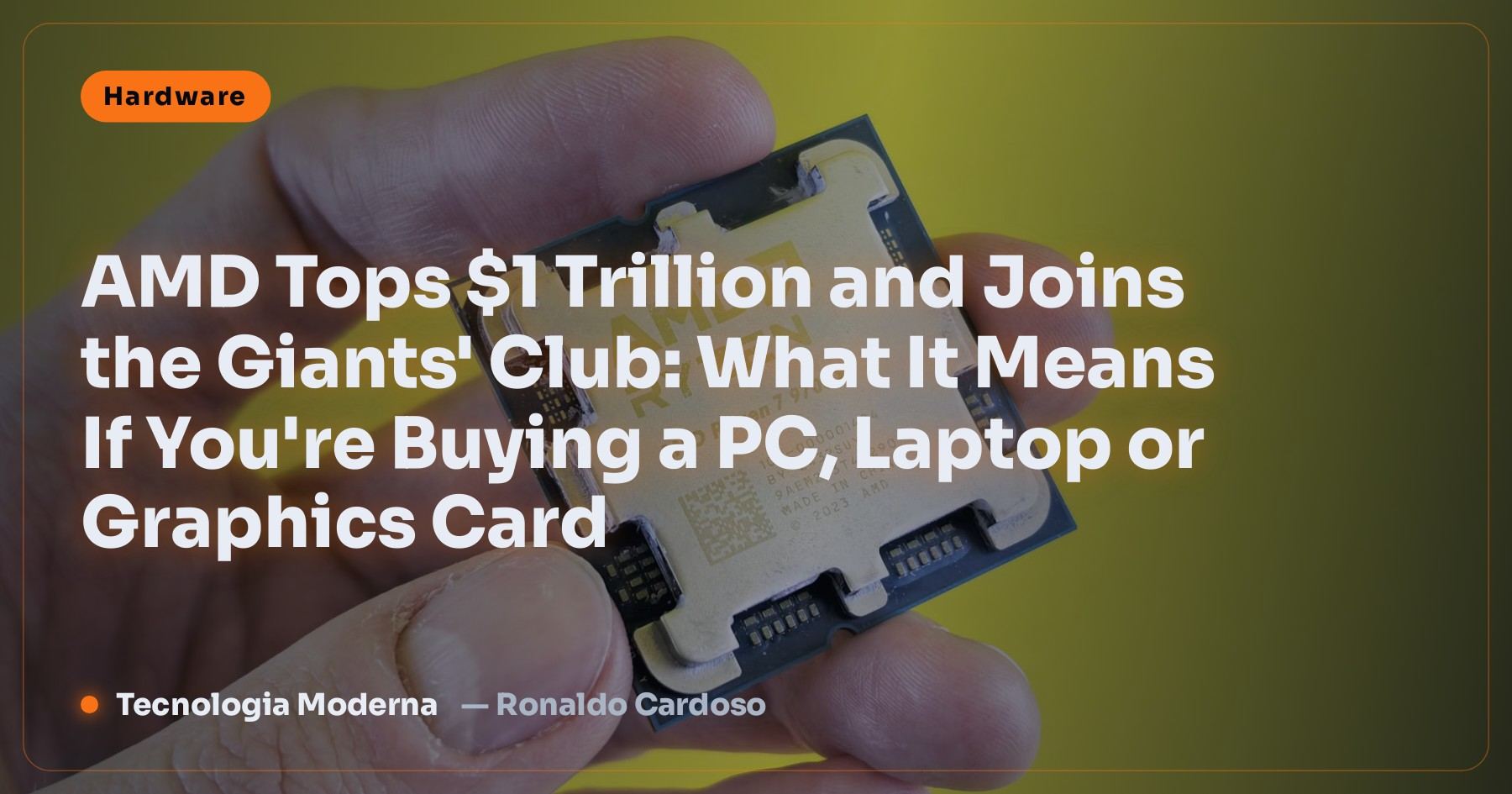
AMD Tops $1 Trillion and Joins the Giants’ Club: What It Means If You’re Buying a PC, Laptop or Graphics Card
Driven by the artificial intelligence race, AMD became the fourth US chipmaker worth more than a trillion dollars. Here’s why it happened, the fight with Nvidia and Intel, and how it affects the price of your next computer.
Straight to the point:
- The fact: on September 21, 2026, AMD shares rose about 9% to 10% in a single day and its market value passed $1 trillion for the first time.
- The club: it’s the fourth US chipmaker to get there, alongside Nvidia, Broadcom and Micron.
- The engine: artificial intelligence — data center revenue (servers and AI accelerators) more than doubled in a year.
- For you: stronger competition with Intel and Nvidia is good in the long run, but the AI boom also pushes up memory and graphics card prices.
- Important: this is news, not investment advice.
- Introduction
- The Chipmakers’ Trillion-Dollar Club
- Why AMD’s Value Soared: the AI Race
- From Near Bankruptcy to a Trillion Dollars
- What This Means If You’re Buying a PC or Laptop
- What About Radeon Graphics Cards?
- Should I Buy Now or Wait?
- And If You’re Thinking About Investing?
- Find Out Whether Your PC Already Uses AMD
- What This Milestone Says About the Tech Market
- Quick Glossary
- Sources
- Frequently Asked Questions
🚀 AMD Hits $1 Trillion: What Happened
On September 21, 2026, AMD (Advanced Micro Devices) had one of the most remarkable days in its history: shares rose nearly 10% and, for the first time, the company’s total stock market value passed one trillion dollars. The jump capped a run of five straight trading days of gains.
To get a sense of scale: a trillion dollars is more than the combined market value of many countries’ largest companies. And AMD got there selling, basically, chips — the same ones found in millions of PCs, laptops and game consoles and, increasingly, in artificial intelligence servers.
🏆 The Chipmakers’ Trillion-Dollar Club
According to the US financial press, AMD became the fourth US chipmaker worth more than a trillion dollars. Here’s the group:
| Company | What it does | Where you find it |
|---|---|---|
| Nvidia | Graphics cards and AI accelerators — the undisputed leader, valued at more than $5 trillion | GeForce cards, AI servers |
| Broadcom | Networking, connectivity and custom AI chips | Routers, phones, data centers |
| Micron | RAM and storage | Memory modules and SSDs (Crucial brand) |
| AMD | Processors, graphics cards and AI accelerators | Ryzen, Radeon, PlayStation, Xbox, EPYC and Instinct servers |
Notice something: they’re all tied to artificial intelligence. Those who make the “picks and shovels” of this race — processing chips, memory and networking — are the ones gaining the most value.
🧠 Why AMD’s Value Soared: the AI Race
Companies like Microsoft, Google, Meta, Amazon and OpenAI are building gigantic data centers to train and run AI models. These data centers need two kinds of chips in enormous quantities:
- AI accelerators (server GPUs) — Nvidia dominates, but AMD has its Instinct line and has been gaining ground with companies that don’t want to depend on a single supplier.
- Server processors (CPUs) — AMD’s EPYC line has taken market share from Intel year after year, and demand grew even more with AI.

The latest earnings show the size of the turnaround:
| Indicator (Q2 2026) | Value | Year-over-year growth |
|---|---|---|
| AMD total revenue | $11.54 billion | +50% |
| Data center revenue | $6.7 billion | +107% (more than doubled) |
| Data center share of revenue | About 58% | Now the company’s biggest business |
In other words: the AMD you know from the Ryzen processor in your PC now makes more money selling chips for servers than for consumers.
📈 From Near Bankruptcy to a Trillion Dollars
It’s the kind of story that becomes a business case study. In the mid-2010s, AMD was in serious trouble and its shares were worth a few dollars. The turnaround started with a few bets:
| Moment | What changed |
|---|---|
| 2017 — Ryzen | Many-core processors at affordable prices, which brought competition back to the PC market |
| EPYC in servers | Efficient server chips that started winning customers from Intel |
| Consoles | PlayStation 5 and Xbox Series use AMD chips — steady revenue and production scale |
| Outsourced manufacturing | Chips made by TSMC, which allowed cutting-edge manufacturing processes |
| 2020s — AI | The Instinct accelerator line and complete systems for data centers |
Today AMD is worth far more than Intel, which for decades owned the processor market outright. If you want to see how this rivalry shows up in your PC, I compared both lines in AMD vs Intel: Ryzen or Core Ultra.
🛒 What This Means If You’re Buying a PC or Laptop
Market value doesn’t change any price the next day. But AMD’s strength has practical effects for anyone buying tech:
| Effect | Upside | Watch out |
|---|---|---|
| Strong competition with Intel | More processor options and more competitive prices in PCs and laptops | — |
| Money for research | More efficient chips every generation, including NPUs for AI on laptops | Pricier launches at the high end |
| Focus on AI servers | Cutting-edge technology trickles down to consumer products | Factory capacity contested by AI can tighten supply of consumer parts |
| AI demand for memory | — | Pressure on RAM and graphics card prices, which already rose in 2026 |

In many countries, add import taxes and exchange rates on top — the same laptop can cost far more outside the US.
🎮 What About Radeon Graphics Cards?
In the gaming graphics card market, Nvidia remains well ahead in market share, and AMD competes mainly on value for money with its Radeon line. The catch is that the same factories and fast memory used in consumer cards are also sought after for AI accelerators, which are far more profitable.

- For gaming: always compare performance per dollar, not the brand. A mid-range Radeon often offers more video memory for the same price.
- For local AI (running models on your PC): Nvidia’s ecosystem is still easier to use, but AMD has been improving support. I cover the details in which graphics card to use for local AI.
- Power supply: stronger cards need a quality PSU — see how to calculate PSU wattage before upgrading.
🤔 Should I Buy Now or Wait?
| Your situation | Recommendation |
|---|---|
| Your current PC is holding back your work or studies | Don’t wait on stock market news: buy what solves it today, with good value |
| You want a new laptop for general use | Recent Ryzen and Intel Core chips handle it very well; look at the screen, battery and SSD before the processor |
| You’re planning to build a gaming PC | Watch prices for a few weeks — memory and graphics cards swung a lot in 2026 |
| Your PC is just slow | You may not even need to replace it: see upgrade or replace your PC and DDR4 vs DDR5 |
⚠️ And If You’re Thinking About Investing?
Two precautions apply to everyone: be wary of anyone promising “guaranteed profits with AMD stock” on social media and messaging apps — financial scams love trending news — and never send money to unknown “managers”. The patterns of these scams are similar to the ones I describe in crypto scams in 2026.
🔍 Find Out Whether Your PC Already Uses AMD
Many people have AMD at home without knowing it. To check your computer’s processor and graphics card without installing anything, open PowerShell and run:
Get-CimInstance Win32_Processor | Select-Object Name
Get-CimInstance Win32_VideoController | Select-Object Name
If you see “AMD Ryzen” or “AMD Radeon”, there you go: you’re part of the story. Take the chance to check your drivers are up to date — for AMD, from the official site or Windows Update, never from “free driver download” sites, as I explain in installing drivers without paid programs.
🌎 What This Milestone Says About the Tech Market
- AI has become the center of the chip industry: the most valuable companies in the sector are the ones supplying data centers.
- Big customers want more than one supplier: depending only on Nvidia is expensive and risky — room for AMD.
- Intel fell behind in market value, but remains huge in PCs and is trying to regain ground with its own manufacturing.
- Consumers feel it indirectly: more innovation reaching laptops (NPUs, efficiency), but also competition for memory and factories.
📖 Quick Glossary
| Term | Meaning |
|---|---|
| Market value | Share price multiplied by the total number of shares — what “the market” thinks the company is worth |
| Data center | A building full of servers that runs websites, clouds and artificial intelligence |
| AI accelerator | A chip specialized in artificial intelligence math, a relative of graphics cards |
| EPYC / Instinct | AMD’s server lines: processors and AI accelerators |
| Ryzen / Radeon | AMD’s consumer lines: processors and graphics cards |
| TSMC | The Taiwanese company that manufactures chips designed by AMD, Apple, Nvidia and others |
📚 Sources
The information in this article was checked against these sources (links open in a new window):
- CNBC — AMD hits $1 trillion for the first time
- Yahoo Finance / Reuters — AMD joins the trillion club
- Tech Insider — earnings and comparison with Intel
If there’s official news, this article will be updated.
FAQ
When did AMD pass $1 trillion?
On September 21, 2026, after a rise of about 9% to 10% that day, capping five straight trading days of gains.
Which other US chipmakers are worth more than $1 trillion?
Nvidia, Broadcom and Micron. Nvidia is the most valuable, worth more than $5 trillion.
Why did AMD’s value rise so much?
Because of artificial intelligence demand. Data center revenue, which includes server processors and AI accelerators, more than doubled in a year and is now most of its revenue.
Will Ryzen processors get more expensive?
There’s no direct link between market value and store prices. What can weigh on prices is the competition for factories and memory caused by AI, plus taxes and exchange rates in each country.
Is AMD now worth more than Intel?
Yes. After the September 2026 rally, AMD’s market value is well above Intel’s.
Should I wait to buy a PC because of this?
No. Buy when you need it and find a good price. It’s only worth watching prices for a few weeks if you’re building a gaming PC, since memory and graphics cards swung in 2026.
Should I buy AMD stock?
This article isn’t investment advice. Tech stocks are volatile; look for official sources and, if appropriate, a certified professional.
Where is AMD in my daily life?
In Ryzen processors in PCs and laptops, Radeon graphics cards, PlayStation 5 and Xbox Series consoles, and many servers that run websites and AI services.
🎮 How much did you learn?
Once you pick an answer it locks in — reload the page to try again.
1. Which market value milestone did AMD pass?
2. What was the main driver of the rise?
3. Which of these companies is also in the US chipmakers’ trillion club?
4. Which AMD line is aimed at servers?
5. Is this news investment advice?
Esse conteúdo ajudou você?
Compartilha com alguém que também vai curtir — é rapidinho e ajuda muito o nosso trabalho a chegar em mais gente.
Conhecimento só tem valor quando compartilhado.
Manter essa estrutura de laboratórios funcionando e produzir conteúdos de engenharia de forma totalmente gratuita e acessível exige tempo e dedicação diária à bancada. Esse guia salvou os seus arquivos? Você pode contribuir diretamente para manter o nosso trabalho independente forte. Apoie doando qualquer valor!
Quer apoiar a nossa bancada independente?
[email protected]